
Featured Speakers
AMTA 2026 Keynote Speaker
Four-Dimensional Electromagnetics
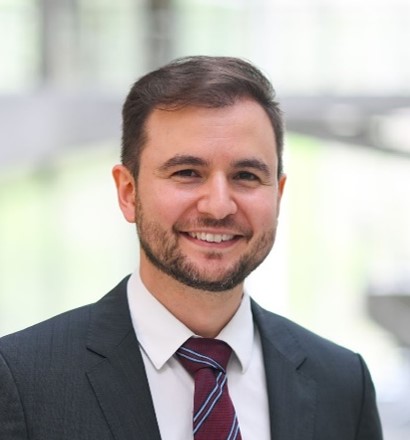
Emanuele Galiffi, PhD
Assistant Professor
Silicon Labs Endowed Faculty Fellow
Chandra Family Dept. of Electrical and Computer Engineering
The University of Texas at Austin
www.galiffilab.org
Linear time-invariant media constitute the foundations of our understanding and applications of electromagnetics, from antenna radiation to wave propagation and scattering. The static nature of time-invariant structures imposes stringent limitations on their properties, and particularly their performance bandwidth, giving rise to fundamental limits such as the Harrington-Chu limit on radiation bandwidth by a small antenna and the Rozanov bound on the bandwidth of a thin perfect absorber. Recently, a new paradigm has been gaining traction, focused on the use of time-modulated elements to overcome these limitations and realize phenomena inaccessible to static electromagnetic systems. In this tutorial lecture, the speaker will provide an overview of the rising field of four-dimensional electromagnetics, elaborating on the new ideas ushered in by combining spatial and temporal degrees of freedom to manipulate electromagnetic waves, envisioning their potential for future applications, and the related challenges and limitations along the way.
Prof. Emanuele Galiffi received his bachelor’s and master’s degrees in physics from Imperial College London in 2016, where he subsequently completed his doctoral studies under the supervision of Prof. Sir John Pendry. For his doctoral research, he was awarded the Johnson Matthey PhD Thesis Prize and a 2020 EPSRC Doctoral Prize Fellowship. He was subsequently awarded a prestigious three-year Junior Fellowship from the Simons Society of Fellows, through which he joined Prof. Andrea Alù’s group at the Advanced Science Research Center of the City University of New York in 2021. He later began a tenure-track appointment at The University of Texas at Austin. His research interests span fundamental and applied electromagnetics and photonics, with a particular focus on metamaterials exhibiting extreme electromagnetic properties, including time-varying, singular, epsilon-near-zero, and highly anisotropic structures. He has co-authored more than 40 peer-reviewed articles in leading journals, including Science, Nature Physics, Nature Photonics, Physical Review X, Physical Review Letters, Nature Communications, and PNAS. His work has received approximately 4,000 citations. For his work on electromagnetic phenomena in time-varying media, he received the 2026 URSI Santimay Basu Award in Radio Science, the 2026 Nanophotonics Early Career Award, and the 2025 SPIE Advanced Photonics Young Innovator Award.
AMTA 2026 AP-S Invited Speaker
Pushing the Boundaries of Computational Electromagnetics – Application to Antenna Designs, Placement, Co-Site Interference Simulations and Digital Twins

Dr. C. J. Reddy
2026 IEEE AP-S President
Fellow IEEE, AMTA Ed Gillespie Fellow, Siemens Fellow
Siemens Digital Industries Software
Siemens
https://www.siemens.com/
Simulation-driven design changed product development forever, enabling engineers to reduce design, iterations, and prototype testing. Increasing scientific computing power expanded the opportunity to apply analysis, making large design studies possible within the timing constraints of a program. This talk will focus on advanced CEM simulation tools that incorporate numerical methods, such as Method of Moments (MoM), Multilevel Fast Multipole Method (MLFMM), Finite Element Method (FEM), Finite Difference Time Domain (FDTD), Physical Optics (PO), Ray Lunching Geometrical Optics (RL-GO), and Uniform Theory of Diffraction (UTD). As the complexity of connected devices increases each day, designers are taking advantage of AI/ML to generate trained models for their physical antenna designs and perform fast and intelligent optimization on these trained models. Using the trained models, different optimization algorithms and goals can be run quickly, in seconds, that can be utilized for comparison studies, stochastic analysis for tolerance studies etc. Use of cloud computing combined with AI/ML, many design iterations can be performed in a short period and reducing the time to market. This talk will also focus on future trends in cloud computing for physics-based simulations and the emerging topics such as Digital Twins.
Dr. C.J. Reddy is Siemens Fellow at Siemens Digital Industries Software. He served as Vice President, Business Development-Electromagnetics for Americas at Altair from 2014 to 2025 and transitioned to Siemens, with the acquisition of Altair by Siemens. Dr. Reddy was awarded the Natural Sciences and Engineering Research Council (NSERC) of Canada Visiting Fellowship to work at Communications Research Center in Ottawa during 1991-1993 and was awarded the US National Research Council (NRC) Resident Research Associateship in 1993 to work at NASA Langley Research Center in Hampton, Virginia. He also worked as Research Professor at Hampton University from 1995 to 2000. Dr. Reddy was the President of Applied EM, Inc (2000-2017) where he led several Phase I and Phase II SBIR projects for the DoD and NASA. He was also the President of EM Software & Systems (USA) Inc (2002-2014) and led the marketing of the EM Simulation tool, Feko in North America. EM Software & Systems (USA) Inc was acquired by Altair in 2014.
Dr. Reddy is a Fellow of IEEE, Fellow of ACES (Applied Computational Electromagnetics Society) and a Fellow of AMTA (Antenna Measurement Techniques Association). Dr. Reddy is a co-author of the book, “Antenna Analysis and Design Using FEKO Electromagnetic Simulation Software,” published in June 2014 by SciTech Publishing (now part of IET). Dr. Reddy served as the Technical Coordinator for AMTA 2020 and AMTA 2021 Conferences and the President in 2022 as well as the immediate Past President of AMTA in 2023. Dr. Reddy also served on the ACES Board of Directors for the term 2023-2026 and served as the Vice President of ACES. Dr. Reddy served as an Associate Editor for IEEE Antennas and Propagation Magazine, IEEE Open Journal of Antennas of Propagation and IEEE Transactions on Antennas and Propagation. He served as the Chair of IEEE Antennas and Propagation Society (AP-S) Young Professionals Committee during 2021-2024 and served on the AP-S AdCom during 2023-2024. Dr. Reddy is appointed to IEEE Fellows Committee by IEEE Board of Directors for the terms 2020-2021 and 2022-2023. Currently, Dr. Reddy is served as the 2025 IEEE AP-S President-Elect and currently serving as the 2026 IEEE AP-S President.
AMTA 2026 EurAAP Speaker
RF Security for Civilian Space Systems

Maria Alberica Saporetti
2026 EurAAP Featured Speaker
Head of Security and Support to Space Systems
Italian Space Agency
https://www.asi.it/en/
Space systems play an increasingly vital role in modern society by providing and supporting critical services. Through its Security Directorate, the Italian Space Agency is committed to protecting space assets and missions. Among the most widespread threats in the space domain are intentional malicious attacks targeting the electromagnetic spectrum. Although such attacks are often primarily military in nature, radio frequency interference (RFI) can also affect governmental and civilian systems and users, resulting in serious safety concerns and economic losses. To enhance the resilience of space systems, effective countermeasures such as anti-jamming antennas with null-steering capabilities are essential. For these applications, radiation performance, sidelobe characteristics, and signal signatures must meet stringent requirements for robustness and a low probability of intercept. Monitoring RFI both onboard spacecraft and on the ground is becoming increasingly important. Finally, emerging needs and challenges in antenna design and measurement for resilient governmental space systems will be presented.
Maria Alberica Saporetti received her M.Sc. degree cum laude in Astronautical Engineering from Sapienza University of Rome in 2008. From 2010 to 2012, she worked at DEIMOS Engenharia in Portugal. From 2012 to 2021, she worked in the R&D department at Microwave Vision Group in Italy. She has contributed to 37 papers and three book chapters and has presented her work at numerous conferences and workshops. She received the “Best Paper Presented by a Woman” award at the inaugural IEEE International Workshop on Metrology for Aerospace. In 2021, she joined the Italian Space Agency as a technologist in the Telecommunication and Navigation sector. In 2023, she joined the Security Directorate, where she currently serves as Head of the Security and Support to Space Systems sector. She has been an active member of the European Association on Antennas and Propagation (EurAAP), where she has served as a Board Director, Team Leader of the Working Group on Antenna Measurements, and Technical Program Conference Chair. She also has academic experience, having taught the Satellite and Space Missions course as an adjunct professor in the Faculty of Aerospace Engineering at the University of Bologna.
AMTA 2026 Lunch and Learn Featured Speaker
Electromagnetic Coupling, Antenna Effects, and Solutions for MRI Safety of Medical Implants

Electromagnetic interactions between MRI systems and medical devices are central to implant safety. MRI exposes patients and devices to static, switched-gradient, and radiofrequency (RF) electromagnetic fields, and conductive implants and leads can couple to these fields in ways that create induced currents, localized electric-field enhancement, and RF heating. From an antenna perspective, the MRI RF transmit coil provides the excitation, while elongated conductive implants and leads can behave as receiving structures whose resonance, orientation, and coupling strongly influence induced currents and localized heating. In this talk, we will present recent research on these electromagnetic mechanisms together with computational, experimental, and certification-oriented methods for evaluating MRI safety. Examples will include passive implantable devices, passive external fixation devices, and active medical devices, with emphasis on RF coupling, antenna and resonance effects, field and current distributions, and measurement and modeling approaches relevant to device and patient safety.
Ji Chen received his Ph.D. degree from the University of Illinois at Urbana–Champaign. After three years at the Motorola Cell Phone Research Laboratory, he joined the University of Houston, where he is currently a Professor in the Cullen College of Engineering. He serves as Director of the NSF Center for Electromagnetic Compatibility Research and the Center for Subsurface Modeling and Characterization. His research focuses on the interactions between medical devices and electromagnetic fields. Dr. Chen is a Fellow of IEEE and AIMBE and has served as Chair of the Department of Electrical and Computer Engineering since September 2024.